


Thick vs thin hair describes hair density: how many strands grow per square inch of scalp. Thick hair means high density; thin hair means low density. Fine and coarse are separate terms describing the width of one strand. You can have fine strands growing densely, or coarse strands growing sparsely.
Fine hair, thin hair, coarse hair, thick hair. Four terms often used interchangeably, though they mean completely different things. To care for the needs of your hair, you need to know the type of hair you’re dealing with: characteristics, differences, challenges, and special needs. In this blog, we break down everything that concerns the thick vs thin hair confusion.
Thick vs Thin Hair: What’s the Difference?
The difference between thick and thin hair comes down to two separate measurements: hair density and hair thickness. Thick hair usually means high density, while thin hair usually means low density.
Hair Density vs Hair Diameter
Hair density is the number of strands that grow per square inch of scalp, while hair thickness/diameter tells how coarse or fine each strand is.
Density varies far more by genetics than most guides admit. A 2017 study reported average crown densities of about 1,458 strands per square inch in participants of Caucasian descent, 1,148 in participants of Hispanic descent and 961 in participants of African descent, all of them normal. There is no density that is too high or too low, and density on its own tells you nothing about hair health. What it tells you is which products and cuts will work, which is what the at-home tests below are for. The most useful comparison is with your own hair over time, not with an average.
Strand diameter is measured in microns, and the cut-off points shift a little between sources. As a working guide, strands under roughly 50 microns are fine, 50 to 80 microns is medium, and anything above about 80 microns is coarse. Human hair spans a wide range overall, with measurements from about 17 to 180 microns on record, so treat these as bands rather than hard lines.
Hair thickness and density serve their purposes. Hair density creates the illusion of fuller-looking, voluminous hair when styled and controls how much scalp shows through. Hair thickness, on the other hand, controls how strong your strands are, how much weight they can carry and tells how prone to breakage your strands are.
Fine Hair vs Thin Hair: Why They Are Not the Same Thing
Fine hair and thin hair are not the same thing. Fine refers to the width of a single strand: a fine strand has a small diameter. Thin refers to how many strands you have: thin hair means fewer follicles per square inch. Fine is about width. Thin is about count.
Fine describes one strand. A fine strand has a small diameter, so it feels soft and almost weightless between your fingers. Thin describes the whole head. Thin hair means fewer strands growing per square inch, so more scalp shows through. You can have fine strands and still have plenty of them, which is why some people with fine hair have a thick-feeling ponytail. You can also have coarse strands growing sparsely, which is why some people with visibly chunky hair still see scalp at the part. Almost every product mistake starts with mixing the two up.
How to Tell If You Have Thick or Thin Hair
To know if you have thick, thin, fine or coarse hair, there are 4 simple tests you can do at home. Two tests cover density (to know if you have thick or thin hair) and the other two cover strand diameter (to tell if your strands are fine or coarse).
Testing Your Hair Density
To know if you have thick or thin hair, we have the scalp visibility check and ponytail circumference test. The latter works when your hair is dry, long and can be wrapped into a ponytail style. You’d measure the ponytail base/hair tie area with a tape: less than 2 inches is thin hair, 2 to 3 inches is medium-density hair, and 4 inches or more is thick hair.
The scalp visibility check suits all lengths of hair. Stand in front of a mirror with a bright light to check if you can see your scalp. Your hair is thin if you see it easily; you have thick hair if it’s difficult to see.
Testing Your Strand Diameter
The most common test is the thread test. You place a single strand of your hair beside a sewing thread on a flat surface and compare sizes. You have fine hair if it’s thinner, medium if they’re similar, and coarse if it’s thicker than the thread.
Another test is the feel/touch test. Pluck a hair strand and place it between your thumb and index finger. You’d barely feel it if it’s fine hair but you’d easily feel the strand when it’s coarse hair.
Our Thick Hair Guide teaches how to maximize and take good care of thick hair!
Thick vs Thin Curly Hair: How Does Curl Pattern Affect the Test?
Your curl pattern does not determine whether your hair is thick or thin. However, curls and coils can affect the results of some density tests.
The ponytail test can make curly hair seem thicker because curls take up more space between strands. A three-inch curly ponytail may contain fewer hairs than a two-inch straight ponytail. If you have curly hair, stretch it straight before measuring, or use another method.
The scalp visibility test can also be misleading. Curly hair sits away from the scalp and can cover areas where the hair is less dense. For a better idea of your density, check your parting when your hair is wet or gently stretched.
The thread test measures something different: the thickness of an individual strand. Your curl pattern does not change the diameter of the strand, making this test useful for determining whether your hair is fine or coarse.
Curl pattern changes what these tests show, not what your hair is. Run the thread test for strand width and check a wet parting for density. Curl distorts both the ponytail and the mirror, but not the strand itself.
Thin Hair or Thinning Hair?
If you have thin hair, it means you’ve been born with low-density hair. But when your hair is thinning, it means your hair is gradually losing volume and your scalp is becoming more visible.
Thin hair is a starting point, thinning hair is a change. If your part has always been wide and your ponytail has measured the same, you have naturally low density hair. However, if your part has widened over the last year, your ponytail has gone down a full wrap, or you are finding more hair in the shower drain, that is shedding rather than hair type, and no shampoo will resolve it. A dermatologist can identify the cause, and the earlier it is looked at, the more options you have.
Benefits and Challenges of Thick vs Thin Hair
When the thick vs thin hair “debate” is on, it’s advisable to look at the benefits and challenges of both.
| Hair Type | Benefits | Challenges |
|---|---|---|
| Coarse Hair | Less prone to breakage; holds styles well; more resistant to heat damage; naturally appears fuller. | Takes longer to dry and style; can feel heavy or bulky; prone to frizz and dryness; may require more product. |
| Fine Hair | Lightweight and easy to manage; dries quickly; requires less product; often looks smooth and sleek. | Breaks and damages more easily; struggles to hold styles; can look flat or limp; easily weighed down by heat or heavy products. |
| High-Density Hair | Naturally full and voluminous; less scalp visibility; offers more styling options; works well with fuller styles. | Takes longer to wash and style; requires more product; can feel heavy or hot; product buildup can occur easily. |
| Low-Density Hair | Easy to wash, detangle, and style; dries quickly; lightweight and comfortable; requires less product. | More scalp visibility; usually has less volume; fewer styling options; heavy products can weigh it down. |
Is Thick Hair Better Than Thin Hair?
No. Neither thick nor thin hair is better than the other. Each has its strengths and weak points. You’d just have to understand what hair type you’re dealing with and how to properly care for it to get the best out of it.
What Is More Attractive, Thin or Thick Hair?
Neither is objectively more attractive. Attractiveness in hair tracks condition rather than density: shine, movement, healthy ends and a cut that suits your face. A well-cut, well-conditioned low-density head reads better than dense hair that is dry, weighed down or grown out. Style to your density instead of against it.
Thick Hair vs Thin Hair in Women: What Changes and When
Hair density can change at different stages of a woman’s life. Pregnancy, postpartum shedding, hormonal changes, age, and repeated tension from hairstyles can all affect how thick or thin the hair looks.
After pregnancy, postpartum shedding often becomes noticeable around two to four months after giving birth. This happens because more hairs than usual enter the shedding phase after pregnancy. For most women, hair density gradually improves as the normal growth cycle returns.
During perimenopause and menopause, hormonal changes can also affect the hair growth cycle. Some women notice their hair becoming less dense or their individual strands becoming finer over time.
Hairstyling can play a role too. Tight ponytails, braids and extensions pull steadily on the follicle, and the American Academy of Dermatology identifies this repeated tension as the cause of traction alopecia, hair loss concentrated along the hairline and temples.
One important point: your ponytail measurement is most useful when you compare it with your own measurements over time. Two women can both have a three-inch ponytail and still have very different hair because strand thickness, texture, and length can affect the measurement. Instead of comparing your ponytail with someone else’s, measure your own hair consistently and track how it changes.
Hair Type Combinations: How Thickness and Density Work Together
By now, you’ve understood that hair thickness and density aren’t the same thing. In real life, your hair isn’t one or the other; it’s a combination of both.
This combination (of thickness and density) is what determines your hair’s look, how it behaves, and how it responds to products and styling.
| Hair Type Combination | Appearance & Challenges | Care & Styling Tips |
|---|---|---|
| Fine + Thick (High Density) | Full and voluminous; soft, lightweight strands; easily weighed down; prone to buildup and oily roots; styles may not last. | Use lightweight volumizing products; avoid heavy products and layering; condition mid-lengths; use root-lifting products; blow-dry for volume. |
| Coarse + Thin (Low Density) | Coarse, noticeable strands but sparse overall; visible scalp; can feel dry and rough; lacks fullness and volume. | Use gentle, hydrating products; deep condition regularly; protect ends; use lightweight smoothing products; avoid tight styles and excessive heat; use light layers. |
| Fine + Thin (Low Density) | Flat and sparse; soft, lightweight strands; visible scalp; lacks volume; breaks easily; styles don't hold well. | Use lightweight volumizing products; handle gently; avoid heavy products; consider blunt cuts; blow-dry for root lift. |
| Coarse + Thick (High Density) | Very full and voluminous; coarse, heavy strands; little scalp visibility; can feel bulky; prone to frizz, dryness, and buildup. | Keep hair moisturized; use rich hydrating products; section when washing/styling; clarify for buildup; use leave-ins and anti-frizz products; use layers to reduce bulk. |
Stylist’s Corner
The mistake most of our stylists at partner salons see is people buying hair products for the hair they see, not the hair they have. Fine strands growing densely look thick in the mirror, so clients reach for heavy smoothing creams that end up flat and greasy by afternoon. Coarse strands growing sparsely look thin, so clients reach for sprays that leave already dry hair rougher.
Before you buy anything, run the thread test and the scalp visibility check. It takes ten seconds and settles a question the mirror cannot. The mirror shows you volume, which is density and strand width tangled together, and volume is exactly what sends people to the wrong shelf.
Best Products for Thick and Thin Hair (GK Hair Recommendations)
The best products for thick and thin hair leave your tresses in better condition than they found them and continue to give your hair what it needs. Fine low-density hair deserves lightweight products that boost its shine without weighing it down, while coarse high-density hair needs products that deeply hydrate and serums to smoothen flyaways and prevent frizz.
At GK Hair, every product is built on Juvexin V2, our plant-based protein derived from quinoa and pea. Because this protein is not hydrolysed, its large molecules work mainly on the hair’s surface while smaller molecules penetrate into the cortex to improve hair structure. This is important because fine hair can easily feel weighed down by too much protein, while coarse hair needs strength and support without extra heaviness. Juvexin V2 is used at different concentrations across our product range to meet both needs.
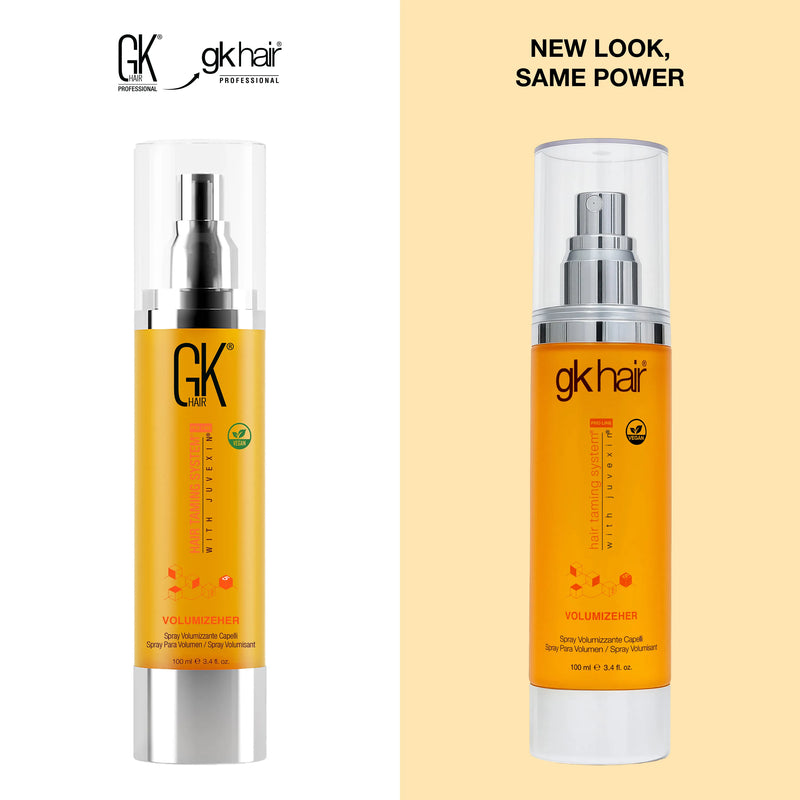
Density drives which format works, not which ingredient. VolumizeHer Spray is the clearest example: on low-density and fine-strand hair, a weightless mist delivers lift at the root that a cream would flatten. It shows why the density-versus-diameter split changes the product, not just the dose.
For Fine + High-Density Hair
- VolumizeHer Spray adds volume to limp hair roots.
- Balancing Shampoo and Conditioner, best for washing fine high density hair. It clears oil at the root without stripping the ends, which is what keeps this hair type from going flat by the afternoon.
- ThermalStyleHer Cream to protect your strands from heat damage.

For Coarse + Low-Density Hair
- GK Hair Deep Conditioner Hair Treatment to lock in moisture and tame frizz.
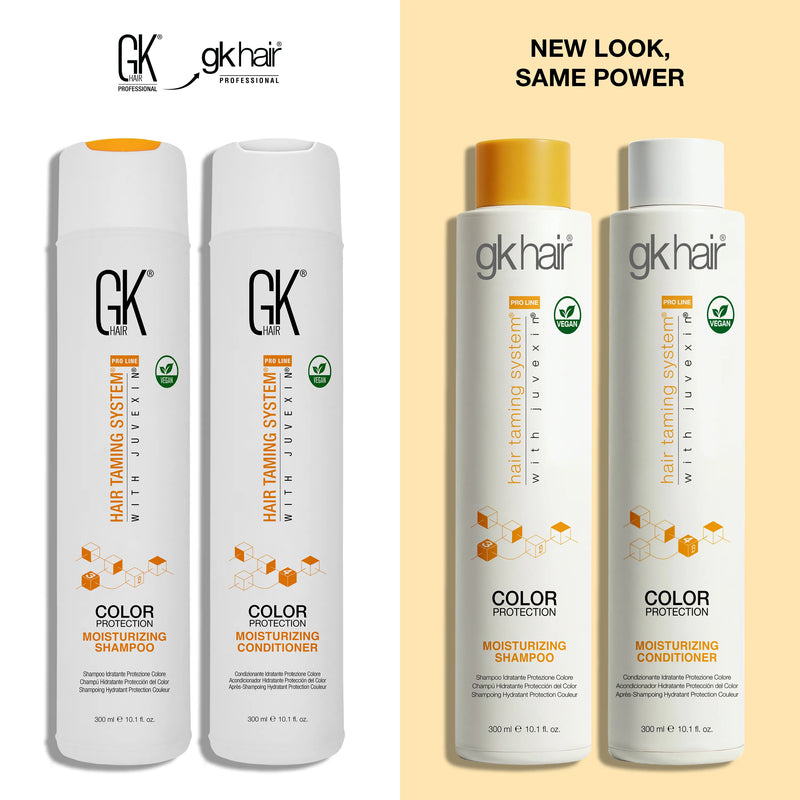
- Moisturizing Shampoo and Conditioner to hydrate your strands.

For Fine + Low-Density Hair
- VolumizeHer Spray
- Leave-In Conditioner Hair Spray, the best lightweight mist, not cream, that detangles and smooths without leaving anything on your strands to flatten it.

For Coarse + High-Density Hair
- Argan Oil Serum to smooth frizz and help you style to your choice.
- Leave-In Conditioner Hair Cream for daily conditioning and protection against dryness.
- GK Hair The Best Hair Treatment: a full keratin smoothing service for coarse strands that grow densely. It cuts down drying time and frizz for 3-5 months with the right aftercare.

Visit our website now to get products to suit your hair type at discounted prices!
Thick vs Thin Hair: Conclusion
The difference between thick and thin hair goes beyond physical appearance. It’s about understanding hair density and strand diameter. Knowing your density and your strand diameter is what turns product shopping from guesswork into a decision. Since 2007 we have built every formula on Juvexin, and today those formulas sit on salon shelves in more than 75 countries. What changes between them is format and weight, a spray for hair that flattens and a cream for hair that roughens, which is why the products above are matched to a specific density and strand-width combination rather than sold as a fix for everyone.
Frequently Asked Questions (FAQs)
Is thick hair healthier than thin hair?
Not necessarily. Thick hair means high density, more strands per square inch, while thin hair means fewer. Neither indicates healthier hair. Condition depends on the state of your cuticle, breakage, moisture balance, chemical processing, heat exposure and scalp health, none of which are determined by how many follicles you were born with.
How can I tell if my hair strands are thick or thin?
You check for your hair’s density by looking at how much of your scalp is visible through your hair or measuring your ponytail circumference. For your strand diameter, compare a single hair with sewing thread: a strand thinner than the thread is fine, while one noticeably thicker is coarse.
Is straight hair usually thinner than curly hair?
No. Curl pattern is separate from both density and strand diameter. Straight hair can be fine, medium or coarse and can grow densely or sparsely, just as curly hair can. Curly hair often looks thicker because its bends create more volume, but that does not mean it has more strands per square inch or a larger strand diameter.
At what age is hair the thickest?
It depends on which measure you mean, because the two peak at different ages. Density peaks first, in the late twenties, and only ever declines from there, because you cannot grow new follicles. Strand diameter keeps building for longer: the two largest studies of women found individual strands reach their widest around age 40 to the mid-forties before gradually getting finer, while in men strand width peaks in the late teens and starts to decline from the mid-twenties. Put together, hair tends to feel its fullest around the mid-thirties, when strands are still thickening but density has begun to fall.
Can women naturally have coarse hair strands but low density?
Yes. Strand diameter and density are separate measurements. A woman can have coarse individual strands and still have relatively few follicles per square inch, which reads as textured but sparse. The reverse is just as common: very fine strands growing densely, which looks abundant in the mirror and flattens under a heavy cream.




Leave a Comment