


Baking soda and apple cider vinegar rinses seem to be two of the internet’s favorite DIY clarifying shampoo tips. While some of that information is true, some will slowly damage your hair in the long run. Chlorine, hard water, and product buildup can all benefit from a true clarifying cleanse. Here’s the truth about what works, what doesn’t, and when you should reach for a formulated option.
Do DIY Clarifying Shampoos Actually Work?
Yes, to a point. Baking soda and apple cider vinegar can strip oil, chlorine and styling buildup, and plenty of people get results doing exactly that. The issue is pH. Healthy hair and shampoo sit at about the same acidity. Baking soda is wildly alkaline, and that is where the problem starts.

We see it all the time in GK Hair’s stylist network: someone walks in feeling like they have been getting their hair properly clean, but it looks dull and tangles more than normal. That is a dead giveaway of a DIY wash gone overboard on pH.
That is the piece people gloss over with DIY clarifying shampoo recipe recommendations. Clarifying vs. regular shampoo, explained, shows that it is really about surfactant strength rather than marketing language. It is also worth noting that detox vs. clarifying shampoo are two different things altogether, since detox shampoos target completely different residues.
Baking Soda Clarifying Rinse: Recipe and Risk
Instructions for the simplest baking soda rinse:
- Add 1 tablespoon of baking soda to 1 cup of warm water and stir until dissolved.
- Apply to shampooed, wet, sectioned hair. Massage thoroughly, focusing on mid-lengths and ends where most buildup collects.
- Wait two to three minutes, then follow immediately with a diluted ACV rinse (recipe below) to help re-seal the cuticle.
- Rinse with cool water. If you are colouring your hair or doing a chemical process that week, skip this step entirely.
Findings published in the International Journal of Trichology support the concern: baking soda has a pH of roughly 9, while the scalp averages about 5.5. Medical News Today adds that alkaline products with such a high pH can irritate the scalp and increase friction between hairs. That article also notes baking soda lifts the cuticle enough to let in too much water, which can weaken the fiber over time, and discourages use on dry, sensitive, or eczema-prone scalps.
If hard water mineral buildup is actually your problem, a chelating shampoo is what strips those minerals away. It is worth understanding chelating vs. clarifying shampoo first, because baking soda alone will not correct mineral buildup completely.
Stylist’s Corner
Our colorists always keep pH strips around. If a client mentions they have been doing home baking soda washes, test a strip before any colour or keratin service. It takes ten seconds and can prevent a disastrous appointment.
Apple Cider Vinegar Clarifying Rinse: Recipe and When to Use It
To use ACV on your hair, dilute 2 to 4 tablespoons of vinegar in 16 ounces of water, pour it over your hair after shampooing, and massage it through the scalp. Let it sit for a few minutes, then rinse. Vinegar works opposite to baking soda: the natural pH of hair sits around 3.7 to 5.5, while ACV comes in at about 2 to 3, which helps bring an overly alkaline scalp back toward normal.
An apple cider vinegar clarifying shampoo DIY recipe is meant to be used as a rinse rather than a primary wash, since vinegar is not a surfactant and does not cleanse on its own. Patch-test the mixture on your wrist 48 hours before first use, as concentrated ACV can irritate skin. Apply no more than twice weekly.
DIY Clarifying Without Baking Soda
For anyone who would rather not work with baking soda, a DIY clarifying shampoo without baking soda can be made from common kitchen ingredients. Diluted castile soap, roughly a tablespoon per cup of water, works because castile soap is an actual surfactant created by fully saponifying plant oils. It lifts grease the way shampoo does, without sulfates or the baking soda pH spike.
Bentonite and rhassoul clay masks work on a different principle. Each is negatively charged and clings to oil and buildup magnetically, drawing it out mechanically as the clay rinses away rather than dissolving it chemically. That makes them among the best natural DIY clarifying shampoo alternatives for sensitive scalps.
Low porosity strands, the ones clarifying shampoo for low porosity hair is centred on, resist moisture and do better with gentle formulas than anything alkaline. Either way, deep condition afterwards or follow with a leave-in or light oil, since even gentle at-home clarifying can leave hair feeling stripped.
DIY Clarifying for Colored Hair
Coloured hair is where a DIY clarifying shampoo for colored hair stops being merely inconvenient and becomes genuinely damaging. Baking soda is alkaline enough to raise the cuticle, letting colour molecules escape along with the buildup, and box-dye or semi-permanent colour fades noticeably faster after even one wash.
Not every clarifying agent behaves the same way on colour-treated hair. A clarifying shampoo for colored hair needs a lower, milder pH than a baking soda paste can ever achieve. Vinegar is the better choice here, because its acidity complements a colour-treated cuticle rather than working against it. Stripping old colour is a different job entirely: using a clarifying shampoo to remove hair dye takes repeated, harsher washes rather than routine buildup removal.
DIY Clarifying for Curly Hair
Curly and coily hair tends to be drier and more porous than straight hair, so a DIY clarifying shampoo for curly hair needs to be gentler than plain baking soda paste. The extra coils and twists hold on to more product and gel, which is exactly why conversations about clarifying shampoo for curly hair tend to revolve around porosity rather than one set approach.
A diluted ACV rinse, or the castile soap method above, clears buildup without wrecking the curl pattern the way straight baking soda can. Always follow with a leave-in conditioner or deep conditioner, since curls dehydrate faster than other hair types.
Common DIY Clarifying Shampoo Mistakes
DIY rinses turn damaging when you:
- Mix baking soda straight from the box instead of diluting it properly.
- Skip the follow-up acidic rinse, leaving cuticles open and hair prone to tangling and snapping.
- Clarify immediately before or after colouring or a chemical or keratin treatment, when your hair needs balanced pH most.
- Use a DIY rinse at every wash instead of only when you notice buildup, drying your hair out over time.
- Assume “natural” means safe. Baking soda sits roughly 3.5 pH points above your hair’s resting level (9 versus 5.5), a bigger jump than most store-bought clarifying shampoos.
DIY vs. a Formulated Clarifying Shampoo
Compare pH balance against consistency and cost and the compromises become clear. If you are undecided on how often to use clarifying shampoo, factor that in as much as which type to use.
| Factor | DIY (Baking Soda / ACV) | Formulated Clarifying Shampoo |
|---|---|---|
| pH control | Swings widely (baking soda ~9, ACV ~2 to 3) | Held closer to hair’s natural range by design |
| Consistency | Varies by how carefully you measure | Same result wash to wash |
| Color safety | Higher fade risk, especially with baking soda | Built to cleanse without stripping tone as aggressively |
| Cost to try | Pantry staples, nearly free | About $10.50 for a 3.4 fl oz bottle |
| Best for | One-off buildup, tight budgets | Regular pre-treatment prep, color-treated or curly hair |
When a Formulated Option Makes More Sense
When buildup becomes too stubborn for DIY methods to handle safely at home, a professional rinse is the better call. That is often right before a colour service or keratin treatment. The extreme pH shift of baking soda and the variability of ACV make consistency impossible, so you cannot count on the same result twice.
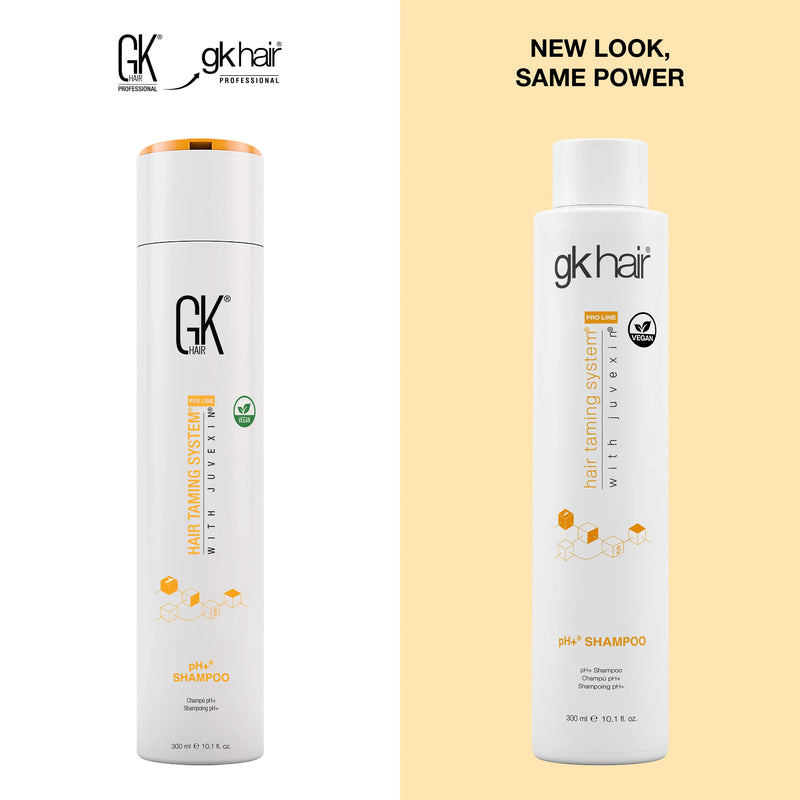
GK Hair pH+ Shampoo is a pre-treatment shampoo designed to strip buildup, chlorine, and oil with ease. Best for: anyone preparing for a keratin or smoothing treatment, or whose hair needs a measured deep cleanse rather than a kitchen-counter concoction. Apply to wet hair, massage through, and let it sit for one to three minutes before rinsing. If you are preparing virgin hair for a treatment, repeat the shampoo up to two more times.

Plant proteins do most of the work in this formula, in the form of Juvexin V2, derived from quinoa and pea. They help repair and fortify from within, while soothing ingredients like aloe vera and pro-vitamins keep the deep cleanse from feeling too strong. That matters for keratin treatments especially, where a drastic pH shift from a homemade rinse can disrupt the bond as it sets.
At about $10.50 for 3.4 fl oz, it is an inexpensive way to see whether a formulated product makes a difference for you. Larger sizes of 10.1 fl oz ($29) and 33.8 fl oz ($62.50) are available if you decide to make it a staple, at a lower cost per wash. Looking for the full sulfate-free range? Browse the GK Hair shampoo and conditioner collection.
Frequently Asked Questions
Is it safe to make your own clarifying shampoo?
Yes, with conditions. Diluted ACV rinses will not hurt most hair if used occasionally. Baking soda is less forgiving, since its alkalinity can dry hair out and fade colour-treated hair with prolonged use. Always patch-test first, use dilute solutions, and treat it as an occasional treatment rather than part of your regular routine.
How often should you use a DIY clarifying shampoo?
Most hair types do best with one to four clarifying washes per month. Clarifying shampoo for oily hair can be used weekly, while dry, curly, or colour-treated hair does better closer to once a month. Any more often and you strip away more moisture than you gain in shine.
Can you use apple cider vinegar and baking soda together?
Yes, and that is usually the more popular method. Baking soda lifts buildup first, then a diluted ACV rinse immediately after lowers pH and seals the cuticle. Without that rinse step, your hair is left in its most alkaline and vulnerable state.
What if I would rather skip DIY clarifying shampoo entirely?
A balanced option like pH+ Shampoo takes the guesswork out of ratios and pH swings. It is formulated as a pre-treatment deep cleanse, and is worth reaching for ahead of a keratin or colour service rather than experimenting on the day.
Does baking soda fade hair color?
Yes, and usually quicker than you would think. It opens the cuticle enough that colour pigment slips out too, so “natural” does not automatically mean colour-safe. If your hair is already coloured and you want to remove buildup without the fading risk, use apple cider vinegar or a formula built for the job.
Clarify Smartly, Not Just Often
DIY clarifying shampoo strips buildup quickly, and apple cider vinegar is the safer half of that equation. Baking soda works too, but the pH is much harsher on colour, on curls, and with frequent use. Looking for a deeper clean without the guesswork? GK Hair’s pH+ Shampoo was formulated for exactly that, so try it before your next treatment.


Dejar un comentario