


Keratin treatment on colored hair can transform a fresh shade into a smooth, polished finish, or leave it patchy if the order of color and keratin isn't planned carefully. It's one of the hair concerns GK Hair stylists deal with most frequently, and getting it right hinges on which treatment comes first, how long you wait between the two services, and how you care for the results afterward.
Keratin Treatment on Colored Hair: Safest Order for Color
Yes, a keratin treatment on colored hair is safe when it's timed correctly. For most color histories, keratin comes first and color follows one to two weeks later so your stylist can true up the tone. Major lightening services, like full highlights or bleach-and-tone work, should happen before keratin instead of after.
Can You Get a Keratin Treatment on Colored Hair?
Yes, keratin treatments are not a problem if you have colored hair, and it is often the best move if dyeing has left the lengths rough, frizzy, or difficult to style. Colored hair does not mean there is an issue, but if you color it repeatedly, the hair can become more porous. That porosity is why your ends can puff up before you even leave the bathroom.
When the cuticle is uneven, light does not go through the hair in one clean sweep. Instead, it's bouncing on dry, raised areas. That is why an eye-catching color can get really dull by week three, even if it is not actually due to fading.
The keratin treatment essentially helps make the hair's surface less problematic. The intention is not to make every head of hair pin-straight like a sheet of glass. The goal is to make your color look richer and smoother while reducing frizz.

Is It Safe for Color-Treated Hair?
Yes, you can safely get a keratin treatment on colored hair when the chemical, heat, and processing time are adjusted based on the hair's condition. Healthy brunette roots and highlighted tips can't be treated in the same way; a professional should first assess each section of hair before starting. A strand test is crucial if you have recently had vivid color or a color correction.
The ends are the indicators. If they tangle while you comb, feel rougher than the rest of the hair, and extend more when you wet them, it means they need a gentler plan. At GK Hair, we don't handle weak, lightened ends like strong hair on the scalp. That's where a customized treatment becomes the key ingredient.
Can You Color Hair After Keratin Treatment or Before?
For most clients, keratin first and color second is the safest order. Keratin can slightly smooth and lift warmth, so coloring afterward makes it easier to refine tone. Major lightening services, like full highlights or bleach-and-tone, should be completed first and followed by a separate smoothing appointment.
After the smoothing service, you'll have an easier time toning, glossing, or refreshing your color, since a flawless tone applied before keratin often needs correcting twice.
If you're going full highlights, a bleach-and-tone transformation, or extreme balayage, color comes first. Let your hair rest, then treat it with keratin as a separate smoothing service.
| Your Goal | Better Order | Why |
|---|---|---|
| Keep your current color but cut down frizz | Keratin, then toner or gloss | Your stylist can refine any warmth afterward |
| Cover resistant gray roots | Keratin, then root color | The final shade is easier to match |
| Go much lighter or add major highlights | Color, then keratin | Bleach should be complete before smoothing |
| Recover from breakage or severe dryness | Repair first | A smoothing service cannot replace a recovery plan |
If You Are Toning, Glossing, or Covering Gray
For most colored hair, keratin first and then color comes afterwards. Many hair treatments can warm or slightly lift the hair like medium brown, red, light brown or porous hair, making the whole color job easier to do so that you can easily tone, gloss or refresh the color after keratin smoothing. That keeps the final color accurate instead of correcting it twice.
If You Are Bleaching or Getting Major Highlights
Major lightening services should happen before keratin. Full highlights, bleach-and-tone transformations, and extreme balayage need to be completed first, then the hair should rest before smoothing. Bleach changes the structure of the hair more aggressively, so keratin works better after the color service is finished.
Is It Safe to Do Color and Keratin on the Same Day?
No, it's not recommended to combine color and a keratin treatment in the same appointment. Doing both at once exposes your hair to heavy chemical processing and heat simultaneously, which can stress the cuticle and make your color less predictable. GK Hair stylists usually schedule these services one to two weeks apart to avoid warmth shifts, patchy coverage, or crispy ends by week two.
Coloring works by opening the cuticle to deposit color, while keratin uses heat to flatten and smooth the hair's surface, two processes that pull the hair shaft in different directions when done back to back.
What to Expect in the First Two Weeks
The first wash is the most fragile moment. Use cool or lukewarm water, apply sulfate-free shampoo gently without piling hair on top of your head, and rinse thoroughly. Color may look slightly warmer in the first week, which is normal and usually settles. By day 10, the treatment is fully cured and your stylist can reassess tone. Avoid ponytails, clips, or anything that creases the hair shaft for the first 72 hours.
How Keratin Affects Hair Color
A keratin treatment on colored hair will not bleach your hair, but at times it may slightly change the color you see in the mirror. You could perceive cool blonde hair as warmer, or red hair as less intense, thanks to the clarifying, heat, and smoothing effects. When it comes to darker hair colors, this difference hardly affects them, and most of the time, you might be more impressed after noticing more shine before you see any lift.
That is why it's important to decide when to apply color if an exact tonal match is a priority, rather than using a smoothing service. A toner or a gloss session is great if you are after the perfect warmth. Guessing beforehand cannot get you there.
Does Keratin Change Hair Color?
Yes, keratin can alter your hair color just a little bit, especially on blonde, highlighted, red, and porous hair. The shift is usually a small amount of lift or warmth rather than dramatic fading, but it can still affect a carefully balanced tone. The degree of lift or warmth also depends on the specific keratin formula and how intensely it is processed; stronger systems may create more visible shifts than softer, color-conscious options. A toner or gloss post-treatment is like a fresh start for your stylist to restore your hair to the right color.
The rule is straightforward: tell your hairstylist if you want your blonde to remain icy cool, your red to remain extremely vibrant, or if you have spent three appointments just to arrive at a cool brunette. Color history should not be simple information. It reshapes the color treatment plan.
Keratin Treatments for Bleached, Highlighted, and Gray Hair
Bleached hair, highlighted hair, and gray hair can all benefit from smoothing, but none of them should be approached casually.
Keratin on Bleached and Highlighted Hair
Bleached and highlighted hair can get a keratin treatment safely, but the fragile mid-lengths and ends need lower heat and fewer flat-iron passes than the rest of the head. A quick elasticity and porosity check before the service tells your stylist how much processing that hair can actually handle.
The bleached ends can look good curled up, but if you brush through them, you'll notice they turn into a fluffy, light-colored ball that's difficult to deal with.
Keratin Treatment on Gray Hair
Gray, resistant hair can also get a keratin treatment safely, though the concern is different from bleached hair: texture, density, and how well the strand responds to heat and dye matter more than fragility. The opposite of the bleached-hair problem can happen with gray hair; it can look healthy and fine but still have stubborn flyaways around the face area.
It's important to change expectations according to the condition of one's hair. If your hair is bleached, experts will check its elasticity, breakage, and porosity. With gray hair, the main features experts are looking at are texture, density, and how well your hair responds to heat and dyes.
Is Keratin Treatment Safe for Bleached Hair?
Yes, keratin treatment can be safe for bleached hair if the hair passes a condition check and the service is adjusted for fragile sections. Bleached hair may need lower heat, fewer flat-iron passes, and more attention to the ends. As Healthline explains, if the hair feels gummy, breaks easily, or stays overly stretchy when wet, moisture and repair should come first.
Professional keratin side-effect guides emphasize checking elasticity, porosity, and breakage before smoothing bleached hair, and adjusting heat and passes accordingly.
How to Cover Grey Hair After Keratin Treatment
When doing a keratin treatment on gray hair, wait one to two weeks and book a targeted root-color appointment. Permanent color is best for resistant gray around the roots and hairline, while a demi-permanent gloss can refresh the lengths without adding more stress. Use sulfate-free care afterward to protect both your coverage and smoothing result.
After coloring, protect the hair with a sulfate-free shampoo and conditioner to prolong both the color and the smoothing results. Hot-water washes are no help if you want to preserve your hair's color. Just a clarifying shampoo every now and then won't suffice either. To enjoy gray coverage and keratin results for a long time, switch to warm water in the shower and use a moisturizing, non-sulfate cleanser.
Choosing the Right GK Hair Keratin Treatment for Colored Hair
The question is not which treatment is better. The question is what your hair is asking for. Some clients need serious help with thick, resistant hair that swells in humidity, while others need softness for dry, bleached lengths that still have to move naturally.
However, there are also clients with thin, bleached, and dry hair at the tips, who need to keep it soft and bouncy without sacrificing their haircut.
GK Hair makes both treatments for different reasons. One will give your hair an amazing, smooth look. The other is for people who are very conscious about their hair coloring, offering a softer, more eco-friendly alternative that leaves hair manageable without any chemical residue.
The Best Hair Treatment: When You Want a Bigger Change
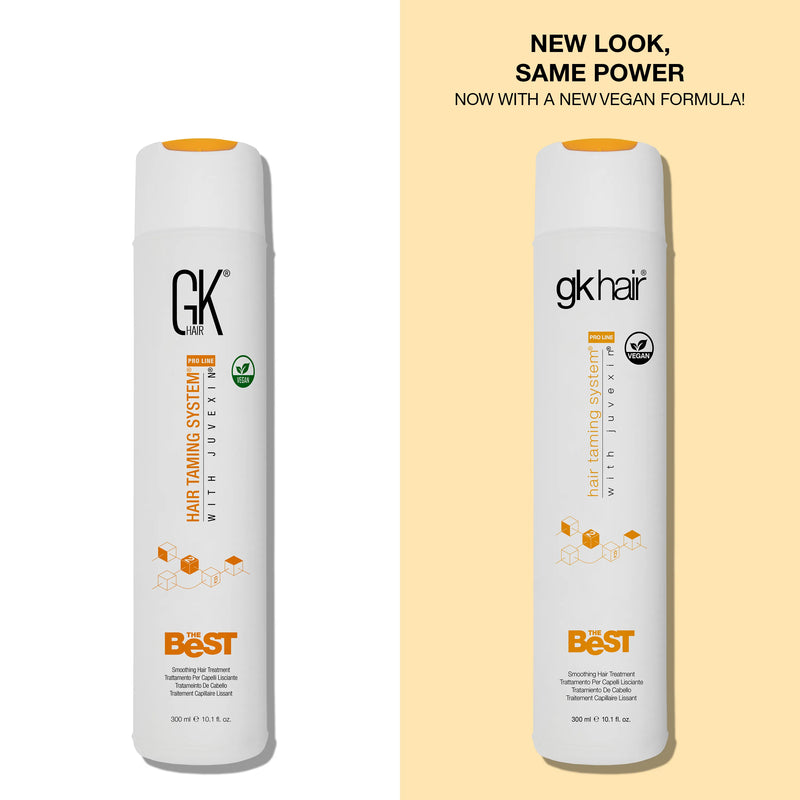
The Best Hair Treatment is best for thick, resistant, curly, color-treated, and frizz-prone hair that needs a stronger smoothing result. This treatment is ideal when your blow-dryer does most of the work every morning and your hair still expands at the crown.

The Best Hair Treatment is formulated with Juvexin V2, a non-hydrolyzed keratin protein blend that penetrates the hair cortex and coats the cuticle. Combined with plant-based smoothing amino acids and herbal seed extracts, the formula strengthens and softens without leaving residue.
Results last 3 to 5 months with proper aftercare, including sulfate-free cleansing and reduced heat exposure, although results vary based on hair type and maintenance routine. Learn more about how long a keratin treatment lasts.
Choose the Best Hair Treatment if you want:
- Less frizz, bulk, and crown puffiness
- Faster blow-drying and simpler styling
- Hair that stays polished longer in humidity
- A stronger smoothing result for thick or resistant texture
- A color-conscious service plan that can be customized around your shade
GK Hair keratin treatments are trusted by professional stylists in more than 75 countries, which gives the formulas real-world validation beyond a single market.
The Best Açaí Hair Treatment: When Softness Is the Priority
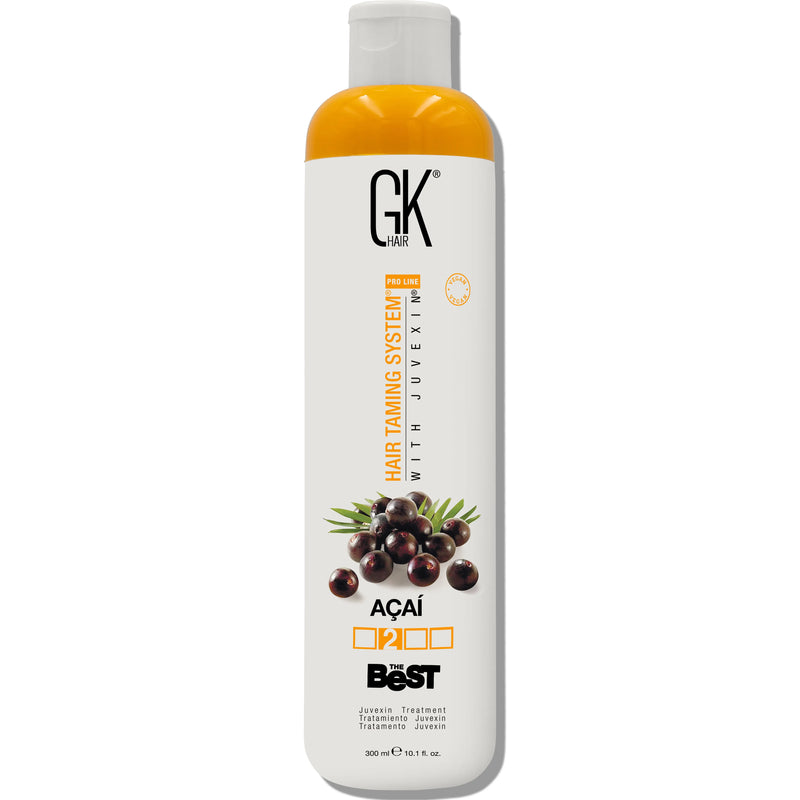
The Best Acai Hair Treatment is best for dry, brittle, tangly, bleached, and color-treated hair that needs softness as much as frizz control. This vegan smoothing treatment uses Vegan Juvexin, Vitamin E, goji berry, and natural conditioning ingredients. A full ingredient list is available on the product page.
 When a client says, “My color looks good, but my hair does not feel good,” this is the product GK Hair stylists reach for.
The Best Acai is not about completely drying out your hair and leaving it flat. It is the perfect choice for those who still want movement, softness, and easily touchable ends, but would like to stop fighting that fuzzy layer that comes up around highlighted hair. The end result should be less cloudiness around the tips and cleaner separation between your hair strands.
Choose the Best Açaí Hair Treatment if you want:
- A vegan smoothing treatment designed with color-treated hair in mind
- More softness through dry or bleach-stressed lengths
- Easier detangling after color services
- Frizz control without a heavy, overly flat finish
- Hair that feels smoother but still moves naturally
Many traditional keratin systems rely on formaldehyde releasers, which can produce strong fumes. GK Hair focuses on formulas developed to deliver long-lasting smoothing without that harsh experience, while still recommending professional application in a well-ventilated salon.
Best Practices for Long-Lasting Color and Smoothness
A good keratin result can be undone surprisingly fast by rough aftercare. Hair that has been smoothed and colored needs less stripping, less scorching, and a little more patience. Your shampoo, water temperature, and hot-tool habits matter more than another bottle on the shelf.
- Use sulfate-free shampoo and conditioner
- Wash with lukewarm water instead of steaming-hot water
- Apply heat protectant before blow-drying or using hot tools
- Keep major bleach and highlight services away from your keratin appointment
- Trim rough ends before they split further up the hair
- Follow our keratin aftercare for colored hair for a routine that protects the result
Stylist's Corner
GK Hair stylists test elasticity on a small wet section before starting: gently stretch a strand and watch how it responds. Hair that springs back quickly can usually handle a stronger formula and higher heat, while hair that stretches and stays elongated needs less heat, fewer flat-iron passes, and often a softer treatment like the Acai formula. That quick check, done before the first drop of product touches the hair, is what keeps color-treated ends from over-processing.
For more guidance, explore our full keratin treatment overview, see before-and-after results on colored hair, or read about the benefits of keratin treatment.
FAQ
Can I Dye My Hair After Keratin Treatment?
Yes, you can dye your hair after keratin treatment but you should wait one to two weeks for permanent hair color. Waiting will not only give the treatment time to settle, but it will also give your stylist time to determine if your tone has shifted.
Will a Keratin Treatment Fade My Hair Color?
A keratin treatment on colored hair can slightly lift or warm hair color, in particular on blonde, red, porous, or highlighted hair, but it should not cause dramatic fading when properly planned. Book a toner, gloss, or color update appointment if your color is a bit off after having the treatment. Sulfate-free shampoos make the color last longer.
What Is the Best Hair Dye for Keratin Treated Hair?
The best hair dye for keratin-treated hair is one selected professionally for your current condition and color goals. Demi-permanent color, low-ammonia dyes, and root-to-tip coverage are typically gentler on keratin-treated hair than at-home bleach. If your hair is already very light or heavily bleached, your stylist may recommend a recovery treatment before another major color change.
What to Know Next
Keratin treatment on colored hair works best as one planned service, not two last-minute appointments squeezed together. Bring your full color history to your consultation, from recent bleaching to gray coverage to how your ends currently feel, so your stylist can map out the right order and timing for your specific hair. Gentle washing, moderate heat, and spacing out chemical services will help both the color and the smoothing last. You can find different keratin treatments to suit your needs at GK Hair or talk to an expert who can tailor your routine just right for your color-treated hair.


Leave a Comment